
GEO vs AEO vs SEO: what’s the difference, and do you need all three?
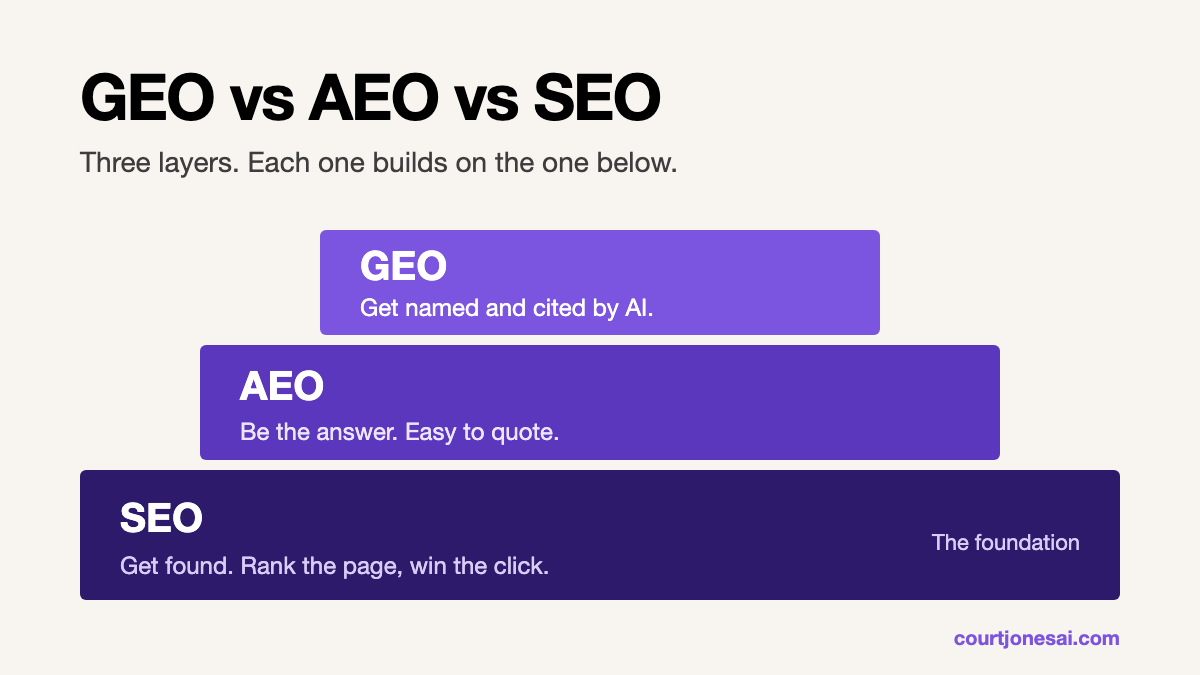
SEO gets your pages ranked on Google, answer engine optimization (AEO) makes your content the direct answer to a question, and generative engine optimization (GEO) gets your brand named and cited when AI tools write the answer. You need all three, because AI answers pull from pages that already rank and earn trust. This is the plain-language guide for B2B marketers and content leads deciding where to start.
Key takeaways
- SEO is still the foundation. Google says its AI features draw on pages in its index and link to supporting sources (Google Search Central).
- AEO makes your content easy to quote: question headings, short direct answers, lists and tables.
- GEO makes your brand worth quoting. Adding citations, quotations and statistics raised visibility in AI answers by up to 40% (Aggarwal et al., 2023).
- GEO doesn’t replace SEO. It builds on it.
- No one controls what ChatGPT says, so measure AI share of voice instead of chasing guarantees.
What is SEO and why does it still matter?
Search engine optimization (SEO) gets your pages found and ranked on Google and other search engines. The goal is the click: a buyer searches, sees your page and visits your site.
It comes down to three jobs:
- Technical: search engines can crawl, read and index your site quickly.
- On-page: each page targets one clear topic, with a title and headings that match how people search.
- Authority: other trusted sites link to you and mention you.
Organic search is where it all started for me, and it’s still the foundation of everything below.
What is answer engine optimization (AEO)?
AEO structures your content so search engines and AI tools use it as the direct answer. It’s what wins featured snippets, “People also ask” boxes, voice answers and spots in Google’s AI Overviews.
In practice, AEO looks like this:
- Headings phrased as the real questions buyers ask.
- A one- or two-sentence answer straight under each heading.
- Lists, steps and tables that can be lifted whole.
- A short FAQ, marked up with FAQ schema.
You’re reading an AEO-structured page right now. Every heading is a question, and every section opens with the answer.
What is generative engine optimization (GEO)?
GEO shapes your content and reputation so AI tools name and cite your brand in their answers. The goal shifts from winning the click to winning the citation.
The term comes from peer-reviewed research. The team found that adding citations, quotations and statistics to content raised its visibility in AI-generated answers by up to 40% (Aggarwal et al., “GEO: Generative Engine Optimization,” Princeton University and others, 2023; published at KDD 2024).
GEO reaches beyond your own website. AI tools build answers from many sources, so it also covers:
- Sourced statistics, quotes and a named author on your pages.
- Brand facts (services, locations, prices) that match across your site, LinkedIn and listings.
- Mentions on the review sites, directories and articles AI already trusts in your category.
Quick note: you may see GEO described as “geographic optimization.” That’s local SEO. In AI search, GEO means generative engine optimization.
What’s the difference between GEO and AEO?
AEO is about how the answer is written on your page. GEO is about whether AI trusts your brand enough to name it. AEO makes your content easy to quote. GEO makes your brand worth quoting.
They overlap a lot, and most good work does both at once. The difference matters when you plan: AEO is mostly on-page rewriting, while GEO also needs off-site work like citations and consistent brand facts.
What’s the difference between GEO, AEO and SEO?
Each one has a different goal, shows up in a different place and needs a different measure. Here’s the side-by-side.
| SEO | AEO | GEO | |
|---|---|---|---|
| Goal | Rank the page and win the click | Be the direct answer | Get named and cited in AI answers |
| Where you show up | Google and Bing results | Featured snippets, “People also ask”, voice, AI Overviews | ChatGPT, Gemini, Perplexity, Google AI Overviews and AI Mode |
| Key tactics | Technical fixes, keyword strategy, on-page content, links | Question headings, direct answers, lists, tables, FAQ schema | Sourced stats and quotes, consistent brand facts, mentions on trusted sites |
| What success looks like | Rankings, organic traffic, leads | Your answer shown or quoted | Your brand on the buyer’s shortlist |
| How to measure | Rankings and clicks | Snippets and AI Overview citations won | AI share of voice across tracked buyer prompts |
Is GEO replacing SEO?
No. GEO builds on SEO. Google says its AI features draw on pages from its index and link to supporting sources, so the pages that rank and earn trust are the ones most likely to be cited (Google Search Central, “AI features and your website”).
It can feel like SEO is fading because clicks are shrinking. In the US, 58.5% of Google searches ended without a click to any website (SparkToro, 2024). But the answer still comes from somewhere. Being named in that answer is the zero-click win.
Here’s what that looks like in real life. Two pages on a site I worked on were competing for “colocation services” in Australia. When I gave each page one clear job, the right page went from #63 to #1 on Google in six days, and it picked up an AI Overview citation. That’s an SEO fix that paid off in AI search. See the full story in my AI visibility case studies.
Should I focus on SEO, AEO or GEO first?
Fix the SEO basics, make your best pages answer-first, then work on getting named across the web. That order works because each step makes the next one count.
- Check access. Make sure Google and AI crawlers can read your site.
- Find the questions. List what buyers search and what they ask AI.
- Rewrite your top pages answer-first. Question headings, direct answers, lists and tables (AEO).
- Add proof. Statistics with named sources, quotes and a named author (GEO).
- Clean up brand facts. Keep services, locations and prices consistent everywhere.
- Earn mentions. Get onto the review sites, directories and articles AI trusts in your category.
- Measure. Track the same buyer prompts every month and report AI share of voice.
When I test a client’s buyer prompts, the problem is rarely missing content. Usually the answer is buried, unsourced or doesn’t match what other sites say about them. That’s good news, because it means the fix often starts with pages you already have.
Not sure what AI says about your brand today? Read what AI visibility is and how to check yours, or start with an AI visibility audit.
Sources
- Aggarwal et al., “GEO: Generative Engine Optimization,” Princeton University and others, 2023; published at KDD 2024. Read the paper
- SparkToro, 2024 Zero-Click Search Study. Read the study
- Google Search Central, “AI features and your website.” Read the guidance
What else do people ask about GEO, AEO and SEO?
Is AEO the same as GEO?
Not quite. AEO shapes how the answer is written on your page. GEO is about whether AI trusts your brand enough to name and cite it, which also depends on what other sites say about you.
Do I still need SEO if I’m doing GEO?
Yes. AI answers draw on pages that already rank and earn trust, so SEO is the foundation that GEO builds on.
How do I measure GEO?
Track AI share of voice: the percentage of relevant AI answers that mention your brand. If you appear in 36 of 200 answers, your share of voice is 18%.
Can anyone guarantee my brand will show up in ChatGPT?
No. No one controls what ChatGPT says. Be wary of anyone who promises a placement. What you can do is measure a baseline, fix the causes and track the same prompts every month.