
What is AI visibility? A plain-language guide for B2B brands
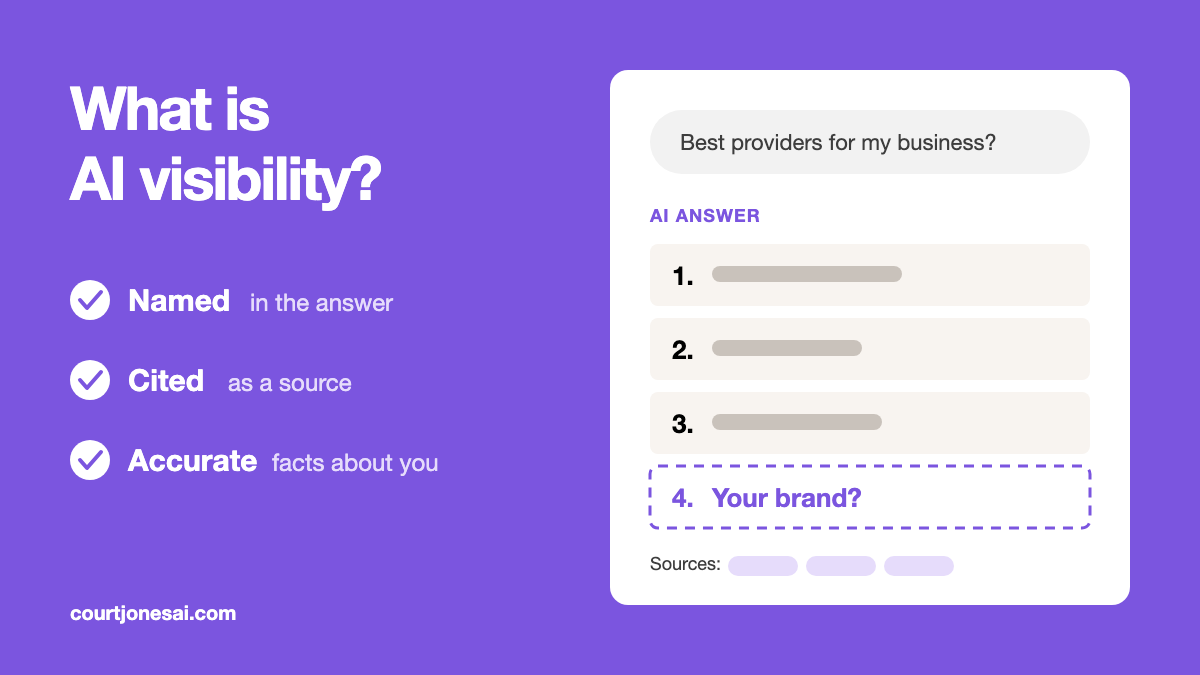
AI visibility is how often, and how accurately, AI assistants like ChatGPT, Gemini, Perplexity and Google AI Overviews mention and cite your brand when buyers ask about your category. For B2B brands, it decides whether you’re on the buyer’s shortlist before they ever talk to sales. If your CEO has asked “why aren’t we in ChatGPT?” and you didn’t have an answer, this is for you.
Key takeaways
- AI visibility has three parts: you’re named in the answer, your site is cited as a source, and the facts about you are right.
- In the US, 58.5% of Google searches ended without a click to any website (SparkToro, 2024). The answer is the new shortlist.
- 61% of B2B buyers prefer a buying experience without a sales rep (Gartner, 2023), so they research with search and AI first.
- Adding citations, quotations and statistics raised visibility in AI answers by up to 40% (Aggarwal et al., 2023).
- Measure it as AI share of voice: the share of relevant AI answers that mention you, tracked on the same prompts every month.
What does AI visibility mean for a brand?
It means AI names you, links to you and gets your facts right when buyers ask. All three matter, and you can win one while losing another.
- Named: your brand appears in the answer, ideally near the top of the list.
- Cited: your website is linked as a source, not just a competitor’s or a review site’s.
- Accurate: what AI says about your services, locations and prices matches the truth.
A brand that’s named but described wrong can lose the deal just as surely as one that’s missing.
Why does AI visibility matter for B2B brands?
Because AI answers name a short list, and buyers increasingly decide without clicking or calling sales. If you’re not on the list, the buyer may never see you.
Two shifts are happening at once:
- From clicks to citations. 58.5% of US Google searches ended without a click to any website (SparkToro, 2024). The buyer reads the answer and moves on. Being named in it is the zero-click win.
- From sales calls to self-service. 61% of B2B buyers prefer a rep-free buying experience (Gartner, 2023). They build their shortlist on their own, with search and AI doing a lot of the work.
This is why I think about AI visibility as preference marketing. Performance marketing captures people who are ready to buy. Preference marketing gets you onto the shortlist before they’re ready to talk. You need both.
How do AI assistants decide which brands to recommend?
They lean on pages that already rank, answers they can lift easily, and facts that agree across the web. No one controls the outcome, but these are the signals you can shape.
- Pages that rank and earn trust. Google says its AI features draw on pages in its index and link to supporting sources (Google Search Central).
- Clear, sourced answers. Content with citations, quotes and statistics was up to 40% more visible in AI answers (Aggarwal et al., 2023).
- Consistent brand facts. When your site, LinkedIn and listings say the same thing, AI has less to second-guess.
- Mentions on trusted sites. Reviews, directories, expert quotes and articles in your category.
- Content anyone can read. If your best insight is behind a form, AI can’t read it, so it can’t cite it.
How do I check if my brand shows up in ChatGPT?
Ask your buyers’ real questions on each AI platform, several times, and record who gets named and cited. One test isn’t enough, because answers change from search to search.
- List your buyer prompts. Mix “what is” questions with buying questions like “best [category] for [use case]” or “[competitor] alternatives.”
- Run each prompt on each platform. ChatGPT, Gemini, Perplexity, Google AI Overviews and Google AI Mode. I run every prompt three times.
- Record what you see. Use a simple sheet like the one below.
- Check the facts. Compare what AI says about you with the truth, and note where errors likely came from.
| Column | What to record |
|---|---|
| Prompt | The exact question, in your buyer’s words |
| Platform | ChatGPT, Gemini, Perplexity, AI Overviews or AI Mode |
| Named? | Yes or no, and your position in the list |
| Cited? | The URL AI linked to, if any |
| Competitors named | Who showed up instead of, or alongside, you |
| Accurate? | Anything AI got wrong about you |
How do I get my company mentioned in ChatGPT?
Make answers easy to quote, add sources, keep facts consistent and earn mentions on sites AI trusts. All of it sits on top of solid SEO, not instead of it.
- Write answer-first. Put a short, direct answer in the first sentence under every question heading.
- Add proof. Statistics with named sources and years, real examples and a named author with a clear bio.
- Clean up your brand facts. Same services, locations and prices on your site, LinkedIn and listings. Add schema markup so machines can read them too.
- Ungate your best thinking. Keep forms for things like pricing tools, not for the insights you want AI to cite.
- Earn mentions. Reviews, directories, expert quotes and guest articles in the places AI already looks.
This works in practice. For a Canadian cloud provider, this approach got the brand cited in 21 Google AI Overviews in Canada, three times the nearest competitor, and named in 8 of 10 tracked buyer prompts. Read how in my AI visibility case studies.
If you’re wondering how this fits with SEO, my guide to GEO vs AEO vs SEO breaks it down.
How do I measure AI visibility?
Track AI share of voice: the percentage of relevant AI answers that mention you versus competitors. If you appear in 36 of 200 answers, your share of voice is 18%.
The key is keeping the prompt set the same every month, so any change in your number is real movement, not different wording. No one controls what ChatGPT says, so I don’t promise placements. I measure a baseline, fix the causes and report the same prompts monthly. That’s what AI share of voice monitoring does, and an AI visibility audit is the fastest way to get your baseline.
Sources
- SparkToro, 2024 Zero-Click Search Study. Read the study
- Gartner, B2B buyer survey, 2023 (61% prefer a rep-free buying experience).
- Aggarwal et al., “GEO: Generative Engine Optimization,” Princeton University and others, 2023; published at KDD 2024. Read the paper
- Google Search Central, “AI features and your website.” Read the guidance
What else do people ask about AI visibility?
Why doesn’t ChatGPT mention my brand?
Usually because AI can’t find clear, sourced, consistent information about you, so it names someone else. Buried answers, unsourced claims and brand facts that don’t match across the web are the most common causes I see.
Is AI visibility the same as SEO?
No, but they’re connected. SEO gets your pages ranked. AI visibility is whether AI names and cites your brand, and it draws heavily on pages that already rank.
How long does it take to improve AI visibility?
Brand-fact and technical fixes can show within weeks. Content and citation work usually takes two to four months.
Does AI visibility only matter for big brands?
No. Local and niche questions have fewer strong sources, so a smaller business with clear, well-cited information can get named quickly. Specific questions are also the ones closest to a buying decision.
Why does AI give different answers every time I ask?
AI answers vary from search to search and from person to person. That’s why I run every prompt several times and track the same prompts monthly, instead of trusting a single test.