
How to measure your AI share of voice (with a free tracking sheet)
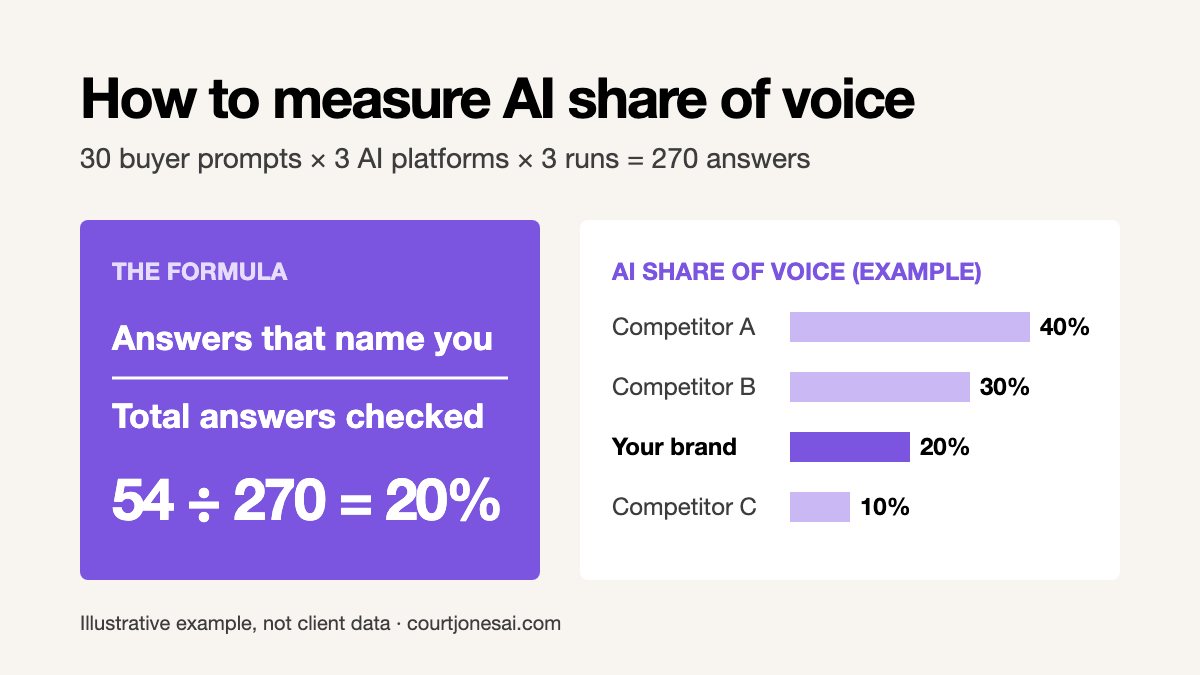
AI share of voice is the percentage of relevant AI answers that name your brand, compared with your competitors. To measure it, pick 20 to 30 prompts your buyers actually ask. Run each one several times on ChatGPT, Gemini, Perplexity and Google’s AI. Count who gets named and who gets cited, then repeat the same prompts every month. Here’s the method I use, plus a free tracking sheet.
Key takeaways
- The formula is simple: answers that name you, divided by all the answers you checked.
- One test isn’t enough. AI tools rarely give the same list of brands twice.
- Track being named and being cited separately. They tell you different things.
- Compare against two or three named competitors, or the number means nothing.
- A spreadsheet works for 20 to 30 prompts. You don’t need a tool to start.
What is AI share of voice?
AI share of voice measures how often AI assistants mention your brand when buyers ask about your category. It’s the AI version of a metric marketers already know from ads and PR.
The formula:
AI share of voice = answers that name your brand ÷ total answers checked × 100
If you appear in 36 of 200 answers, your share of voice is 18%. Run the same count for each competitor and you can see who AI recommends most.
Some tools calculate it differently: your mentions divided by every brand mention in the answers. Either works. What matters is that you use one method and stick with it, so this month compares fairly with last month.
Why can’t I just ask ChatGPT once?
Because the answer changes almost every time you ask. In a January 2026 study, SparkToro and Gumshoe.ai ran 12 brand-recommendation prompts 2,961 times across ChatGPT, Claude and Google’s AI. ChatGPT and Google returned the same list of brands less than 1% of the time. The same list in the same order came up less than 0.1% of the time (SparkToro, 2026).
So a single screenshot of ChatGPT naming you, or ignoring you, proves very little. The study also suggested that how often you appear across many runs is a steadier signal than where you rank in any one list. That’s why share of voice counts appearances, not positions.
How do you measure AI share of voice, step by step?
Choose your prompts and competitors, run every prompt several times on each platform, record who’s named and cited, then calculate. The setup takes an afternoon. After that, each monthly check takes a couple of hours by hand.
1. Choose 20 to 30 buyer prompts
Use the questions your buyers really type, in their words. Good sources are sales call notes, the questions prospects email you and your Google Search Console queries.
Leave your brand name out of most prompts. You want to know whether AI suggests you on its own. Mix the buying stages:
- Problem: “How do I keep customer data in Canada?”
- Shortlist: “What are the best cloud backup providers for MSPs?”
- Comparison: “Is [competitor] or [competitor] better for a mid-size company?”
Shortlist prompts matter most. They’re the closest to a buying decision.
2. Pick two or three competitors
Measured alone, your share of voice has no context. Choose the competitors you lose deals to, plus any brand AI keeps naming that you didn’t expect. That surprise brand is often the most useful finding.
3. Choose your AI platforms
For most B2B brands I track four: ChatGPT, Gemini, Perplexity and Google’s AI Overviews or AI Mode. Each one draws on different sources, so your share of voice can be strong on one and weak on another.
4. Run each prompt at least three times
Use a fresh chat each time, logged out or with memory off, so your past chats don’t steer the answer. Three runs per prompt per platform is a practical minimum by hand. More runs give a steadier number.
5. Record who’s named, who’s cited and whether it’s right
For every answer, log the brands named, the URLs cited and whether what AI says about you is accurate. Wrong prices, old product names and missing services are common, and they cost you deals quietly.
6. Calculate, then repeat monthly
Count the answers that name each brand and divide by the total. Then run the same prompts on the same platforms next month. Don’t change the prompt list halfway, or your trend line breaks.
What does the math look like?
Here’s an example with made-up brands. Thirty prompts, three platforms and three runs each gives 270 answers.
| Brand | Answers that name it | AI share of voice |
|---|---|---|
| Competitor A | 108 of 270 | 40% |
| Competitor B | 81 of 270 | 30% |
| Your brand | 54 of 270 | 20% |
| Competitor C | 27 of 270 | 10% |
The shares don’t have to add up to 100%, because one answer can name several brands. The useful part comes next: break the number down by platform and by prompt. You might find you win problem prompts but vanish on shortlist prompts, which tells you exactly what to fix.
Named vs cited: what’s the difference?
Named means AI mentions your brand in its answer. Cited means AI links to your page as a source. You need both, and they don’t always move together.
A brand can be named often but rarely cited, which usually means AI knows you from other sites, not your own pages. Or your pages can be cited for facts while a competitor gets the recommendation. Track them as two columns, not one.
What does tracking show you in practice?
I led AI search visibility in-house for a Canadian cloud service provider, and we tracked buyer prompts and AI citations against named Canadian competitors. In July 2026 a competitor was cited in 19 Google AI Overviews to our 11, and AI assistants still rarely named the brand. A ranking report alone would have looked like steady progress.
Because we saw the gap, we refreshed our two key pages in late September. By September 30, the client was cited in 21 AI Overviews, three times its nearest Canadian competitor, and 8 of 10 tracked buyer prompts named the brand in ChatGPT, Gemini and Perplexity. Read the full story of how it became the most-cited source.
Get the free AI share of voice tracking sheet
I’ve put the columns I use into a sheet you can copy. It opens in Google Sheets or Excel.
Download the tracking sheet (CSV)
Each row is one answer: date, platform, prompt, buying stage, run number, brands named, whether you were named, whether your page was cited, the cited URLs, whether the answer was accurate, and notes. To get your share of voice, count the “yes” rows in the “You named?” column and divide by the total rows. In Google Sheets, that’s =COUNTIF(G:G,"Yes")/COUNTA(G2:G).
Should you use a tool or a spreadsheet?
Start with a spreadsheet. With 20 to 30 prompts, it’s the cheapest way to learn what AI says about you, and you’ll read every answer instead of skimming a dashboard.
Move to a tool when you need more prompts, more markets or weekly checks. Before you pay, ask how many times each prompt is run and whether the method is published. Rand Fishkin’s advice after the SparkToro study was to be wary of tools that don’t share their research. Be especially wary of any tool that reports a single “AI ranking position.”
If you’d rather not run it yourself, AI share of voice monitoring tracks the same buyer prompts every month against up to three competitors and ends with three next steps for your team.
What’s a good AI share of voice?
There’s no universal benchmark yet, so be careful with anyone who quotes one. A good share of voice is one that beats your direct competitors on the prompts closest to a sale, and keeps rising month over month. Your first month is your baseline. Every fix after that is measured against it.
New to the topic? Start with what AI visibility is and how GEO, AEO and SEO differ. Or get a one-time baseline with an AI visibility audit.
Sources
- Rand Fishkin and Patrick O’Donnell, “AIs are highly inconsistent when recommending brands or products,” SparkToro, January 2026. Not peer reviewed. Read the research
- Client data: Semrush Position Tracking and AI Visibility (Google Canada, 2024–2026). The client isn’t named.
- The table in “What does the math look like?” is an illustrative example, not client data.
What else do people ask about AI share of voice?
How many prompts do I need to track?
Twenty to 30 is enough to start. Choose the questions closest to a buying decision, and run each one at least three times on each platform.
How often should I measure AI share of voice?
Monthly suits most B2B brands. Use the same prompts and platforms every time, so each month compares fairly with the last.
Can I measure AI share of voice for free?
Yes. A spreadsheet and a few hours a month is enough for 20 to 30 prompts. Paid tools help when you need more prompts, more markets or weekly checks.
Does AI share of voice include Google AI Overviews?
It should. Google’s AI Overviews and AI Mode are where many buyers first see an AI answer, so track them next to ChatGPT, Gemini and Perplexity.